
Glendale Heights Directory Collections
No single shelf spans the full history of Glendale Heights. The strongest verified collection combines public scans, locked reference volumes, nearby phone books, local newspapers, and archive records. The date and geographic label matter as much as the surname because the Village did not exist under its current name in the oldest volumes.
| Collection | Years | Where held | Access |
|---|---|---|---|
| Bumstead’s Wheaton and DuPage directory | 1915-16 | Internet Archive, linked by Wheaton Library | Free digitized scan and OCR |
| McDonough’s DuPage County Directory | 1925-26 | Illinois Digital Archive | Free public-domain scan, 1,188 pages |
| DuPage County directory | 1924-25 | Wheaton Library | In-library, non-circulating |
| Wheaton city directories | 1940 and 1950 | Wheaton Library | In-library, nearby-city comparison |
| Wheaton-Warrenville Polk | 1999 | Wheaton Library | Local-history collection |
| West Suburban Haines criss-cross | 1988-2021 | Wheaton Library | Address-to-name reference volumes |
| Near West Suburban Haines | 2004-2021 | Wheaton Library | In-library reverse directory |
| Wheaton and nearby phone books | 1951-2016 | Wheaton Library | Published phone and address entries |
| Local newspaper titles | 1960s-2000 | Illinois newspaper catalogs and microfilm | Run and scan access varies |
| IRAD DuPage records | 1839-1955, series-dependent | Northern Illinois University | Catalog, request, or archive visit |
Publication gaps do not prove a person left the area. A resident may be unlisted, recorded under another city, absent from one year, or indexed badly by OCR. Record the publisher, exact volume year, page, and access date for each find.
Glendale Heights Directories Nearby
Wheaton Public Library Local History is the strongest verified specialist shelf near Glendale Heights. Staff help with DuPage and house history. Its directories, Haines books, and phone books are kept in a locked, non-circulating collection, so contact the reference desk before visiting and arrive with names, dates, addresses, and spelling variants.
The library’s page shows the scope of this city directory resource.
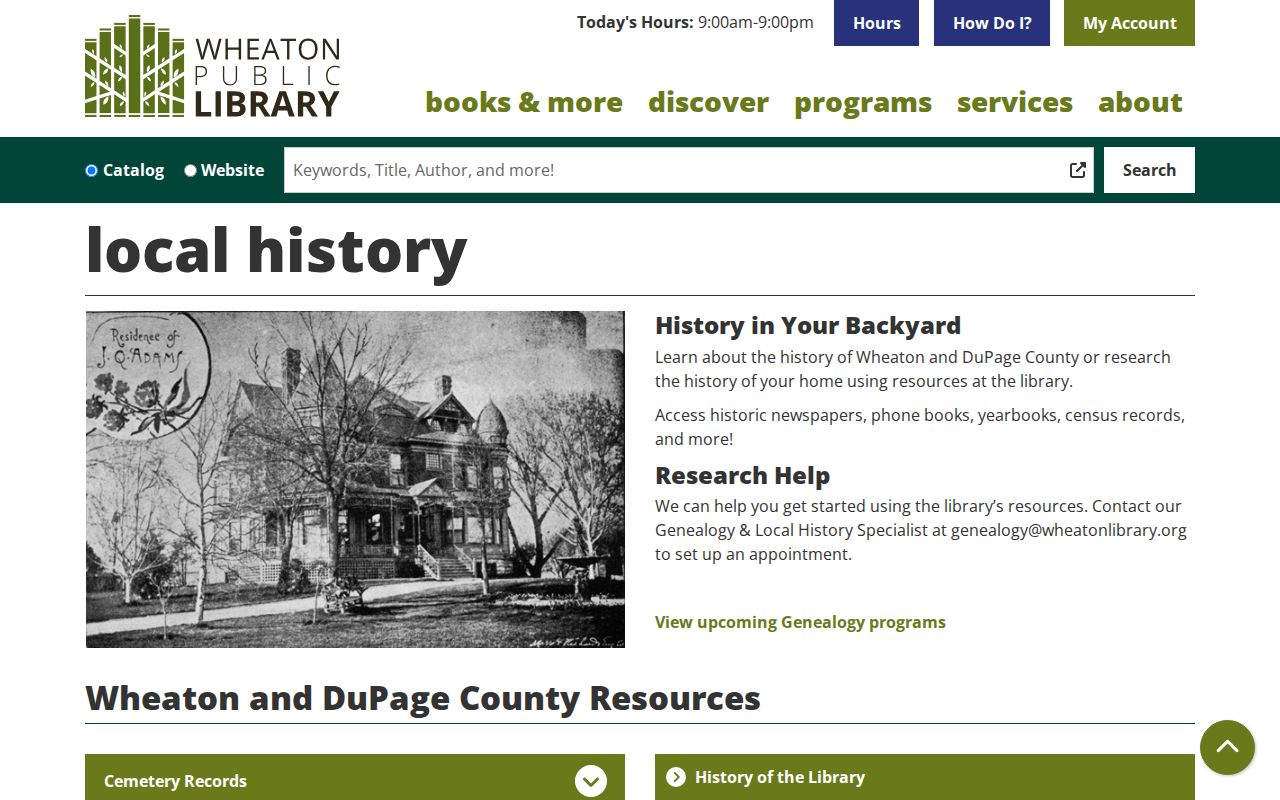
The collection bridges two search directions. Traditional volumes begin with a surname and lead to an address. Haines criss-cross volumes begin with a street address and lead to the published name. Phone books can fill some intervening years, though people with unpublished numbers will be absent.
Library split. Glenside supplies current databases and newspapers; Wheaton holds the verified print directory and criss-cross shelf.
Digitized DuPage City Directories
The 1915-16 Bumstead’s Directory is a searchable scan linked by Wheaton Library. Its OCR can expose a name quickly, but the image should settle spelling and layout. Entries show names, parenthetical spouse or relative names, a business or occupation, street address, telephone, and abbreviations such as “r” for residence.
The scan gives a concrete model of how a historical city directory looks.
It is evidence for Wheaton and DuPage County, not proof that a named person lived inside modern Glendale Heights. Read the title page, locality headings, and abbreviation key before copying an entry.
The 1925-26 McDonough’s DuPage County Directory has 1,188 pages with residents arranged by city plus a rural section. Naperville Public Library contributed it, and Naper Settlement is listed as publisher. Search the rural pages and nearby towns when the modern address area is known.
Why Glendale Heights Is Missing
The 1925-26 directory does not list Glendale Heights among its cities. That absence reflects local chronology, not empty land. The area remained largely rural through the 1950s, incorporated as Glendale in 1959, and changed its name to Glendale Heights in March 1960 after a conflict with another Illinois Glendale.
Before 1959, search rural DuPage, a farm or route name, and nearby labels such as Glen Ellyn, Bloomingdale, or Wheaton. For 1959 and early 1960, test Glendale with DuPage County and a road or surname. This avoids confusing the old local name with the southern Illinois place that prompted the rename.
The first known homes near Glen Ellyn Road, Larry Lane, and Fullerton mark the rapid suburban change described by Village history. Earlier county records can still cover the land even when a city directory has no Glendale Heights heading.
Note: A missing municipal heading is a clue about record geography, not proof that the household or parcel did not exist.
Read Glendale Heights Directory Entries
Transcribe the whole line, not just the surname. A spouse, phone, occupation, or residence mark can separate people who share a name. OCR often breaks columns and abbreviations, so compare the text result with the scanned page and save the volume’s key.
| Name | Usually the indexed person or householder; given names may be abbreviated. |
|---|---|
| Parentheses | May identify a spouse or relative, depending on the publisher’s key. |
| Business or occupation | Helps distinguish same-name entries and may supply another address. |
| Residence | House number and street, sometimes preceded by “r.” |
| Telephone | A dated published number, not proof of present contact. |
| Widow notation | A possible family-history clue that needs obituary or vital-record confirmation. |
- Criss-cross directory
- A volume organized by street address, useful when the name is unknown.
- Householder index
- A name list centered on the person associated with the household entry.
- Abbreviation key
- The publisher’s explanation of shortened terms and symbols, often near the front.
- OCR
- Machine-read text from a scan; it is convenient but can misread names and columns.
Trace Glendale Heights Family History
City directories are annual or periodic snapshots. They work best in a sequence with census, deed, and newspaper evidence. The public federal census reaches through 1950 under the current 72-year release rule. Later directory and phone-book years can help bridge the period after that census without proving every member of a household.
- Choose the first likely year and search the surname plus variants. If the place predates incorporation, use rural and nearby-city sections.
- Copy the full entry, page, publisher, year, spouse notation, occupation, phone, and address exactly.
- Move forward and backward through available years. Mark a disappearance or changed address as an open question, not a confirmed move or death.
- Pair the nearest census year with the directory line. Compare household members, age, birthplace, address geography, and neighbors.
- Confirm ownership with the county deed or tax trail. For modern address-keyed work, use the Glendale Heights street directory.
- Close a gap with a dated obituary, marriage notice, probate file, naturalization record, or cemetery source.
Maintain a timeline with separate columns for source date and event date. A phone book can lag after a move, a directory can omit one year, and a business address can be mistaken for a home. The source image should remain attached to each conclusion.
Glendale Heights Newspaper Directories
Local papers act as informal people indexes when a printed city directory falls short. The official holdings map includes the Glendale Heighter monthly in 1960-61 with scattered later years, Glendale Heights Press from 1975-1999 with a related 2000 title, Examiner titles from 1981-1992, Star titles from 1975-1981, and Glenside microfilm from 1975-1981 with gaps.
Search birth and marriage announcements, obituaries, anniversaries, civic clubs, school events, election notices, and local officials. A matching street, spouse, age, or group can distinguish the right person. Newspaper evidence remains a lead, so compare it with another dated record.
Glenside Library’s November 2025 NewsBank announcement adds home access for valid cardholders to the Chicago Community Collection. The service includes current and archived local articles, obituaries, and birth or marriage announcements, and is updated daily. That current route complements the older microfilm catalog rather than replacing it.
Glendale Heights Archive Fallbacks
When the directory year is missing, begin with the institution most likely to hold the needed record. IRAD’s DuPage holdings include marriage records from 1839-1932, birth records from 1877-1919, death records from 1877-1928, death and burial permits from 1916-1926, and naturalization material from 1885-1955. The Northern Illinois University depository provides the catalog and request route.
The DuPage County Historical Society and Bess Bower Dunn Museum can help with photographs, organizations, maps, manuscripts, and county context. Detailed current catalog fields and research fees were not verified, so contact the institution with a focused name, locality, and date.
No official Village cemetery lookup, complete local funeral-home obituary index, or exact Glendale Heights Sanborn map was verified. Do not substitute the nearby 1924 Glen Ellyn map. Church registers and cemetery files may help when the institution confirms access, but private membership lists should not be assumed public.
Glendale Heights Records Timeline
The collection makes more sense when its milestones are placed in order. The change from county books to scans and suburban directories reflects how the community grew, not a single continuous publication.
| 1839 | DuPage County formed; county marriage and administrative records begin. |
|---|---|
| 1915-16 | Bumstead’s Wheaton and DuPage directory provides a digitized early example. |
| 1924-26 | DuPage print and digitized volumes cover nearby cities and rural sections. |
| 1950 | Latest standard public federal census in the current release window. |
| 1959-60 | Glendale incorporated, then became Glendale Heights. |
| 1960s-2000 | Verified local newspaper titles document the developing Village. |
| 1988-2021 | West Suburban Haines volumes provide reverse address snapshots. |
| 2025 | Glenside added the Chicago Community Collection through NewsBank. |
This timeline also explains the apparent gap between a rural 1925 entry and a later suburban address. The custodian and naming system changed. Preserve each historical place label instead of forcing it into the modern city field.